

Chapter 5 | 3 min read
Diagonal Spread Strategy
In our Previous chapter on Horizontal Spread Strategy, we shared how traders take advantage of options with the same strike price but different expiring months to have an edge over time decay and volatility differential.
Now, we add variety to this topic with our Diagonal Spread Strategy, taking the best of a vertical and horizontal spread in combination to give us flexibility through a directional trading approach. Let's dive in to see how this can really push and improve your game even further in the Indian market.
What is a Diagonal Spread Strategy?
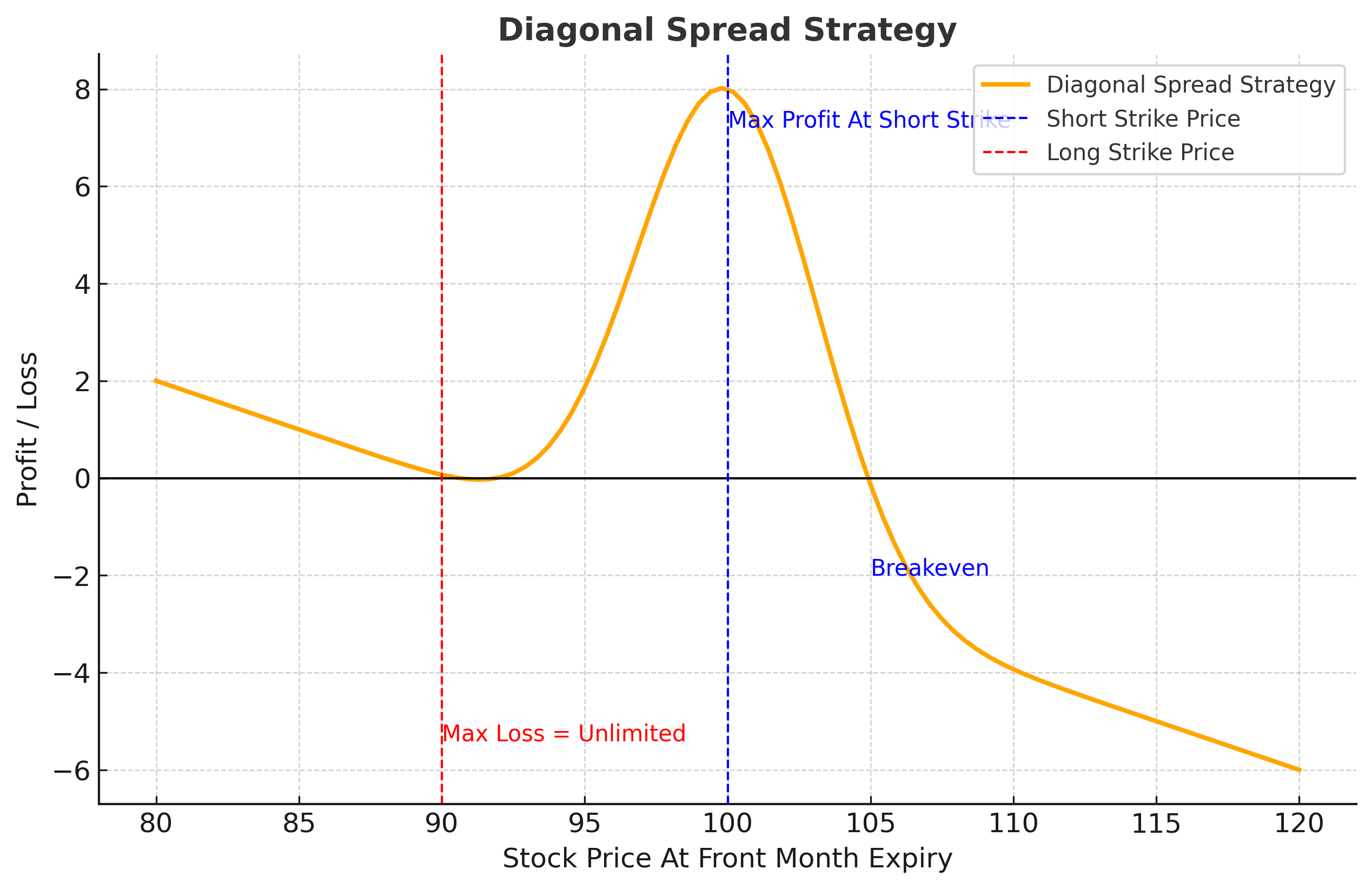
The Diagonal Spread Strategy is an advanced option strategy that involves
- Buying a longer-term option (farther expiration) at one strike price.
- Selling a shorter-term option (nearer expiration) at a different strike price.
This strategy creates a diagonal relationship between strike prices and expiration dates, hence the name. It allows traders to take a directional view on the market while taking advantage of time decay and volatility changes.
For example:
- A Diagonal Call Spread is used in a bullish market.
- A Diagonal Put Spread is ideal in a bearish market.
Why Indian Traders Love It
The Diagonal Spread Strategy fits well in the options market in India due to a high degree of liquidity combined with expirations on a frequent basis. Herein is why it is gaining traction:
1. Directional Flexibility: The trader can realize profits through either bullish or bearish movements while minimizing the risks associated.
2. Time Decay Benefit: The shorter-term option decays faster, and traders can collect the premium.
3. Volatility Edge: The longer-term option benefits from increased volatility as it rises in value.
When to Use the Diagonal Spread?
This strategy works perfectly in situations like:
1. Directional View: When you expect the underlying asset to move upward or downward moderately.
2. Anticipation of Volatility: This is used when the volatility is low but anticipated to increase.
3. Event-Driven: More applicable for pre-earnings or pre-policy setups when markets have given back some sort of a directional bias.
How to Set It Up - An Example
Bullish Example : Diagonal Call Spread
Assume Nifty is trading at 19,600, and you are expecting a moderate rise:
- Buy a longer-term Nifty 19,600 Call (e.g., expiry in three weeks).
- Sell a shorter-term Nifty 19,800 Call (e.g., expiry this week).
Bearish Example: Diagonal Put Spread
If you expect Nifty to fall moderately:
- Buy a longer-term Nifty 19,600 Put (e.g., expiry in three weeks).
- Sell a shorter-term Nifty 19,400 Put (e.g., expiry this week).
Key Benefits
-
Profit from Multiple Factors: Time decay, volatility changes, directional moves work in your favor.
-
Lower Cost: Selling the shorter-term option helps offset part of the cost from the longer-term option.
-
Defined Risk: Loss is limited to the net debit paid and, hence, controlled exposure.
Risks to Watch
The Diagonal Spread Strategy is limited-risk, however, its profitability is dependent upon the market's prediction. An underperforming underlying position or contract in implied volatility may negatively affect it.
Conclusion
The Diagonal Spread is an extremely versatile and dynamic strategy. It offers traders in India a great way of balancing views about the direction, time decay, and volatility. It is a great strategy with which one can capture moderate price movements and has added potential for profit due to the flexibility and control that it has on risks. After this advanced strategy, we will understand the Collar Strategy, a follow-up in this strategy series for a conservative, highly-effective, and powerful means to hedge positions and lock profits in a strategy that must become important knowledge for every trader or investor.
Recommended Courses for you















Learn, Invest, and Grow with Kotak Videos
Explore our comprehensive video library that blends expert market insights with Kotak's innovative financial solutions to support your goals.

Trading with collateral as margin with Kotak Neo

How India is Redefining Space Exploration

