

Chapter 3 | 3 min read
Liquidity Ratios: Current Ratio, Quick Ratio in Excel
Liquidity ratios are essential tools for assessing a company’s ability to meet its short-term obligations. They measure how well a company can pay off its current liabilities using its current assets. In this chapter, we’ll explore two important liquidity ratios—Current Ratio and Quick Ratio—and how to calculate them using Excel for financial analysis.
What Are Liquidity Ratios?
Liquidity ratios gauge a company’s ability to cover its short-term liabilities with its short-term assets. They help investors, creditors, and analysts determine if the company is financially stable in the short term.
-
Current Ratio: Measures the ability of a company to cover its current liabilities with its current assets.
-
Quick Ratio: A stricter version of the current ratio, focusing on the most liquid assets by excluding inventory.
Current Ratio
The Current Ratio reflects the company’s ability to pay off its short-term liabilities with its short-term assets. A ratio greater than 1 indicates that the company has more current assets than current liabilities.
Formula for Current Ratio:
Current Ratio = Current Assets / Current Liabilities
Step-by-Step Guide: Calculating Current Ratio in Excel
Step 1: Input Data
Let’s assume you have the following financial data for a company:
- Current Assets = ₹500,000
- Current Liabilities = ₹300,000
₹500,000 | ₹300,000 |
Step 2: Apply the Current Ratio Formula
In Excel, apply the formula for the Current Ratio:
=Current Assets / Current Liabilities
For this example: =500000 / 300000
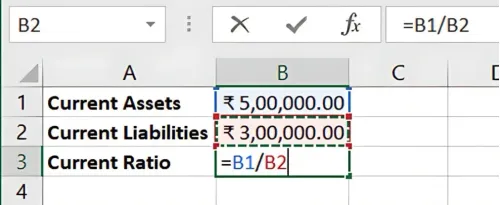
Result: The Current Ratio is 1.67.
This means the company has ₹1.67 in current assets for every ₹1 of current liabilities, indicating good short-term financial health.
Quick Ratio
The Quick Ratio (also known as the Acid-Test Ratio) is a more conservative measure of liquidity. It excludes inventory from current assets because inventory is not as easily converted to cash. The quick ratio focuses on the most liquid assets: cash, marketable securities, and accounts receivable.
Formula for Quick Ratio:
Quick Ratio = (Current Assets - Inventory) / Current Liabilities
Step-by-Step Guide: Calculating Quick Ratio in Excel
Step 1: Input Data
Let’s assume the company has:
- Inventory = ₹150,000
In addition to the current assets and liabilities, you now exclude inventory to calculate the quick ratio.
₹500,000 | ₹150,000 | ₹300,000 |
Step 2: Apply the Quick Ratio Formula
In Excel, the formula is:
=(Current Assets - Inventory) / Current Liabilities
For this example:
=(500000 - 150000) / 300000
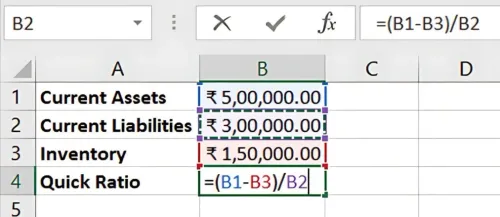
Result: The Quick Ratio is 1.17.
This means the company has ₹1.17 of the most liquid assets for every ₹1 of liabilities, showing it can cover short-term obligations without relying on inventory.
Why Use Liquidity Ratios?
- Assess Short-Term Solvency: Liquidity ratios help determine if a company can meet its short-term debts.
- Investor Confidence: High liquidity ratios give investors confidence that the company is financially stable.
- Credit Analysis: Lenders often look at liquidity ratios before issuing short-term loans.
Key Takeaways:
- The Current Ratio includes all current assets, providing a general view of short-term liquidity.
- The Quick Ratio focuses on the most liquid assets by excluding inventory, offering a more conservative measure of liquidity.
- Excel makes it easy to calculate and compare liquidity ratios by automating the formulas and providing instant results.
Conclusion:
Calculating liquidity ratios like the Current Ratio and Quick Ratio is essential for evaluating a company’s ability to meet short-term liabilities. Excel simplifies these calculations, making it a valuable tool for financial analysis.
Next Chapter Preview: In the next chapter, we’ll dive into Debt Ratios such as the Debt-to-Equity Ratio and Debt Ratio, which help assess a company’s long-term solvency and financial leverage. Stay tuned!
Recommended Courses for you















Learn, Invest, and Grow with Kotak Videos
Explore our comprehensive video library that blends expert market insights with Kotak's innovative financial solutions to support your goals.

Trading with collateral as margin with Kotak Neo

How India is Redefining Space Exploration

